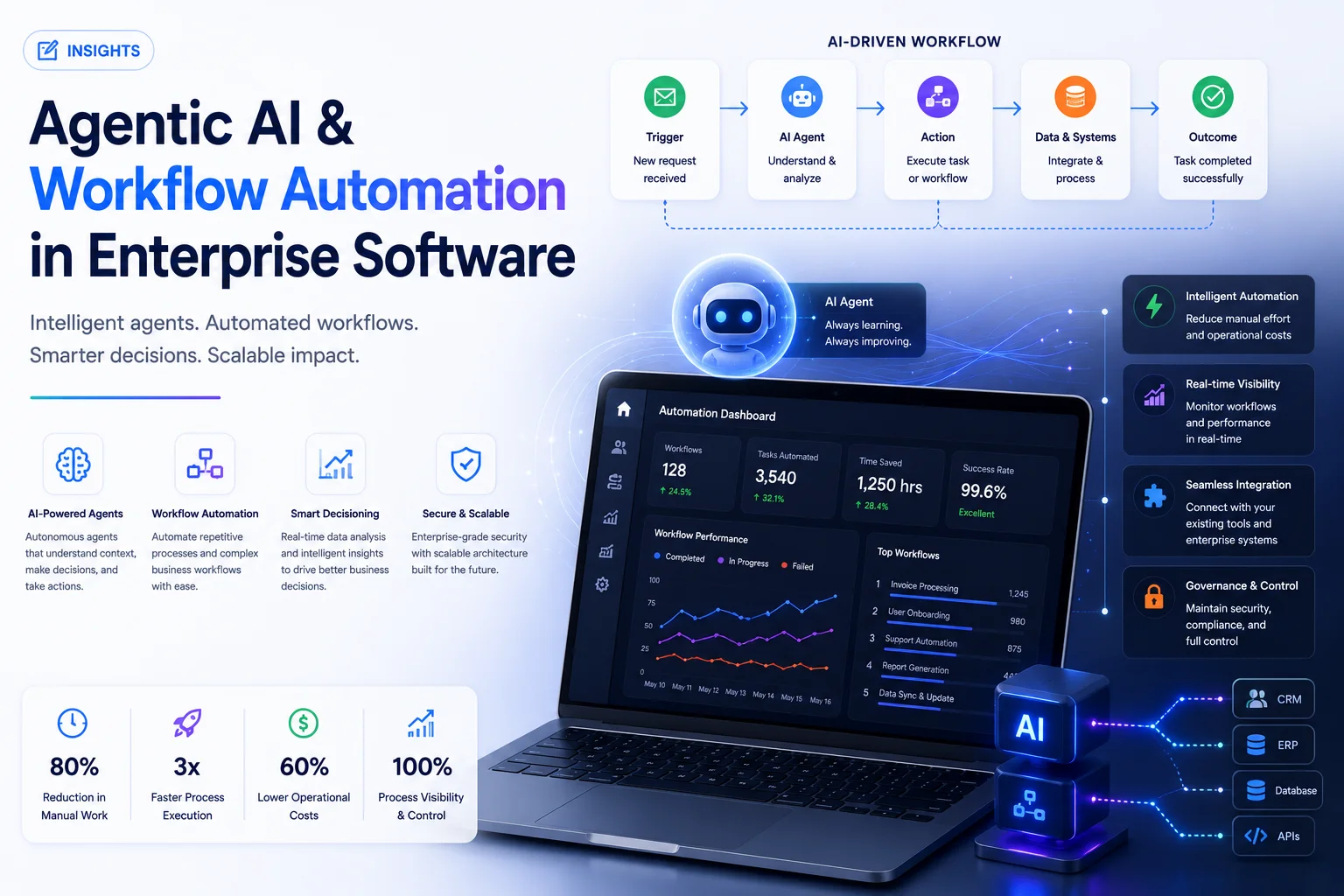
Artificial Intelligence has evolved beyond basic chatbot interfaces into agentic decision engines capable of reasoning, planning, and executing multi-step business workflows. In modern enterprise software engineering, rigid hardcoded business logic is rapidly being augmented by autonomous AI agents that handle complex, unstructured data streams with high precision.
1. The Paradigm Shift: Beyond Hardcoded Rules
Traditional enterprise software relies heavily on deterministic decision trees and rigid if-else business rules. While effective for predictable inputs, deterministic systems crumble when encountering unstructured PDFs, natural language emails, non-standard invoice formats, or dynamic operational exceptions.
Traditional Flow: Input Data ──> Hardcoded Parser ──> Strict Logic ──> Output (Fails on variance)
Agentic AI Flow: Input Data ──> LLM Reasoning Engine ──> Tool Selection ──> Execution & Verification Loop
By embedding Agentic AI loops, enterprise applications transition from static data repositories into dynamic operational partners:
- Autonomous Tool Execution: AI agents can inspect database schemas, construct SQL/GraphQL queries, call external REST endpoints, and validate results before delivering final answers.
- Context-Aware Reasoning: Rather than matching static strings, agents evaluate intent, sentiment, entity relationships, and historical organizational context.
- Self-Correction & Fallbacks: If an API call fails or an invoice data point is ambiguous, the agent can retry with modified parameters, flag the record for human review, or apply contextual heuristics.
2. Core Architecture of Enterprise AI Agents
Building production-grade AI agents requires a resilient architecture that guarantees data privacy, deterministic guardrails, and low-latency execution.
 ┌─────────────────────────────────────────────────────────────────────────┐
 │                       Enterprise Agent Pipeline                         │
 └─────────────────────────────────────────────────────────────────────────┘
                                     │
                                     ▼
 ┌─────────────────────────────────────────────────────────────────────────┐
 │ 1. Ingestion Layer: Multi-modal documents, Webhooks, API Web Streams    │
 └─────────────────────────────────────────────────────────────────────────┘
                                     │
                                     ▼
 ┌─────────────────────────────────────────────────────────────────────────┐
 │ 2. Vector Retrieval (RAG): Pinecone/pgvector semantic context match      │
 └─────────────────────────────────────────────────────────────────────────┘
                                     │
                                     ▼
 ┌─────────────────────────────────────────────────────────────────────────┐
 │ 3. LLM Reasoning Kernel: Structured Schema Validation (Zod/Pydantic)   │
 └─────────────────────────────────────────────────────────────────────────┘
                                     │
                                     ▼
 ┌─────────────────────────────────────────────────────────────────────────┐
 │ 4. Guardrails & Security: PII Anonymization + RBAC Authorization        │
 └─────────────────────────────────────────────────────────────────────────┘
                                     │
                                     ▼
 ┌─────────────────────────────────────────────────────────────────────────┐
 │ 5. Execution & Audit: Real-time database update + Immutable audit log   │
 └─────────────────────────────────────────────────────────────────────────┘
A. Multi-Tenant Vector RAG (Retrieval-Augmented Generation)
To ensure AI models operate on accurate internal company knowledge without hallucination, we integrate enterprise vector storage (such as PostgreSQL with pgvector or Qdrant). Document embeddings are chunked, indexed, and retrieved dynamically based on vector similarity scores.
B. Structured Schema Enforcers (Pydantic / Zod)
Raw model outputs can be unpredictable. Enterprise agents developed at Devzuno Technologies enforce strict schema validation using TypeScript Zod or Python Pydantic models. If an AI agent attempts to output malformed JSON, the schema validator automatically prompts a targeted self-correction retry loop before code execution.
3. High-Impact Enterprise Use Cases
1. Automated Invoice & Logistics Document Parsing
Supply chain and manufacturing enterprises process thousands of vendor invoices weekly. Custom AI agents automatically parse unstructured PDF documents, reconcile line items against purchase orders in ERP databases, extract GST/Tax IDs, and queue payments—reducing manual data entry by over 85%.
2. Autonomous Customer Support & Ticket Escalation
Instead of legacy keyword-matching bots, agentic support tools analyze ticket context, query account billing histories, execute password resets or refund workflows via API, and seamlessly hand off complex edge cases to human support teams with complete situational summaries.
3. Regulatory Compliance & Contract Auditing
Legal and procurement teams leverage AI audit agents to scan vendor contracts for non-standard indemnity clauses, expiration dates, and liability caps, highlighting risk factors in seconds.
4. Governance, Security, and Human-in-the-Loop (HITL)
Deploying AI within core business infrastructure demands uncompromising security protocols:
- Strict Data Boundaries: Zero data retention policies ensure enterprise proprietary data is never used to train public foundation models.
- Role-Based Access Control (RBAC): AI agents inherit user authorization scopes, preventing unauthorized data exposure across enterprise departments.
- Human-in-the-Loop (HITL) Thresholds: Actions carrying high financial or operational impact (e.g., approving invoices over $5,000 or sending external client emails) require explicit human sign-off via interactive dashboard queues.
- Immutable Audit Trail: Every reasoning step, prompt template, tool execution, and SQL query is logged to audit databases for complete operational transparency.
5. Modern Tech Stack for Agentic AI Systems
| Layer | Recommended Enterprise Technologies |
|---|---|
| Foundation Models | Claude 3.5 Sonnet, OpenAI GPT-4o, Llama 3 70B (Self-hosted) |
| Orchestration Frameworks | LangChain, LlamaIndex, Custom Python Async Microservices |
| Vector DB / Retrieval | Pgvector (PostgreSQL), Qdrant, Pinecone |
| Frontend & Control Portals | Astro 5, React 19, Tailwind CSS |
| Backend & Microservices | Node.js / TypeScript, FastAPI (Python), Docker, Kubernetes |
6. How Devzuno Technologies Partners with Enterprises
At Devzuno Technologies, we engineer custom agentic AI pipelines and custom enterprise applications tailored to complex business workflows. Learn more about our Enterprise AI Solutions, explore our AI Automation Solutions, or read our blueprint on Building Enterprise RAG Systems with PostgreSQL pgvector. From initial workflow discovery and vector architecture design to high-throughput deployment and ongoing model evaluation, we turn operational friction into automated software efficiency.
Whether you are seeking to modernize legacy enterprise systems in Uttar Pradesh (Lucknow, Sonbhadra) or launch a global AI-driven SaaS platform, our team builds production-ready software platforms engineered for scale.
Frequently Asked Questions
Q1: How do Agentic AI agents differ from standard AI Chatbots?
Standard chatbots simply generate conversational text responses based on static prompts. Agentic AI systems possess operational autonomy—they can break complex goals into tasks, call external software APIs, query databases, verify their own work, and trigger real-world business actions.
Q2: Is our proprietary business data safe when using AI agents?
Yes. At Devzuno Technologies, we design enterprise AI integrations using dedicated VPC endpoints, enterprise-grade encryption (AES-256 at rest, TLS 1.3 in transit), and zero data retention agreements with foundation model providers.
Q3: How long does it take to deploy a custom enterprise AI workflow?
A typical production-ready Agentic AI microservice (such as automated document parsing or ticket routing) takes 3 to 6 weeks from architecture discovery to production staging and validation.
Ready to Automate Your Enterprise Workflows?
Contact our engineering team at Devzuno Technologies to discuss custom AI solutions, SaaS platform engineering, and enterprise digital transformation.