Large Language Models (LLMs) like GPT-4o, Claude 3.5 Sonnet, and Llama 3 have transformed enterprise computing. However, out-of-the-box LLMs suffer from three critical production vulnerabilities: hallucinations, stale training cutoffs, and a complete lack of access to private corporate knowledge bases.
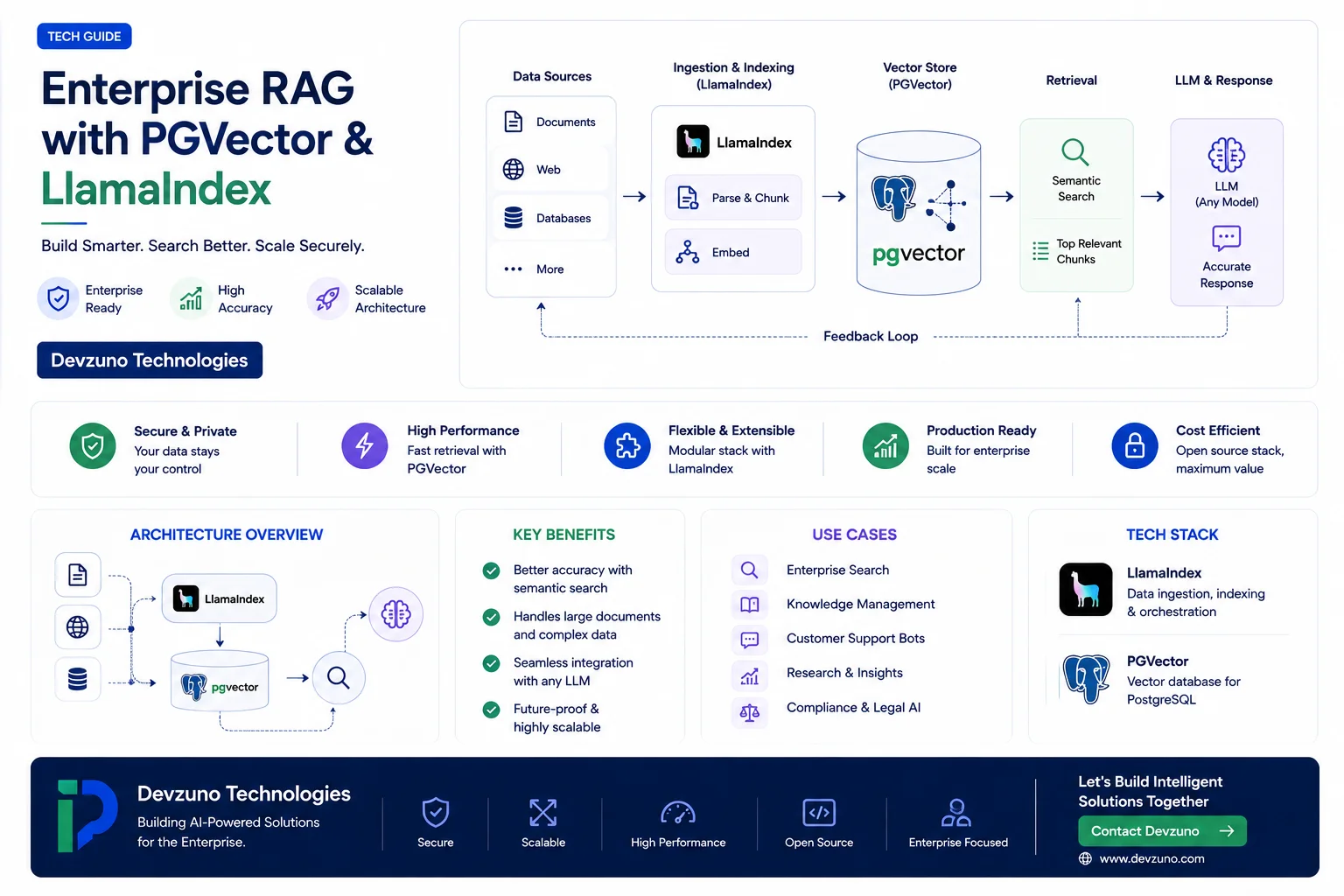
To overcome these barriers, enterprise technology teams build Retrieval-Augmented Generation (RAG) Systems. A production-grade enterprise RAG architecture retrieves relevant internal document chunks from a vector database in real-time, injecting verified domain knowledge directly into the LLM context prompt.
While early AI prototypes relied on standalone vector databases like Pinecone or Weaviate, modern enterprise AI architectures prefer PostgreSQL with the pgvector extension coupled with LlamaIndex. This stack combines ACID transactional security, existing enterprise SQL infrastructure, and high-performance HNSW vector indexing.
Partnering with an enterprise AI engineering firm like Devzuno Technologies enables organizations to build secure, scalable RAG systems that eliminate hallucinations while enforcing strict row-level document security. Explore our Devzuno Enterprise AI Solutions or our guide on AI Workflow Automation for Enterprises.
1. RAG Architecture Spectrum: Naive RAG vs. Advanced Hybrid RAG
Understanding the evolution from primitive RAG prototypes to production-grade Advanced RAG is critical for system design:
┌───────────────────────────────────────────────────────────────────────────┐
│                          USER NATURAL LANGUAGE QUERY                      │
└─────────────────────────────────────┬─────────────────────────────────────┘
                                      │
                                      ▼
┌───────────────────────────────────────────────────────────────────────────┐
│                QUERY TRANSFORMATION & HYBRID VECTOR SEARCH                │
│    (Sub-Query Decomposition + Dense Vector Embeddings + BM25 Lexical)     │
└─────────────────────────────────────┬─────────────────────────────────────┘
                                      │
                                      ▼
┌───────────────────────────────────────────────────────────────────────────┐
│               RECIPROCAL RANK FUSION (RRF) & RERANKING ENGINE              │
│               (Cohere Rerank v3 / BGE-Reranker-Large Filtering)           │
└─────────────────────────────────────┬─────────────────────────────────────┘
                                      │
                                      ▼
┌───────────────────────────────────────────────────────────────────────────┐
│               ENTERPRISE LLM GENERATION & GUARDRAIL AUDIT                 │
│         (Context Injection + NeMo Guardrails + Citation Attribution)       │
└───────────────────────────────────────────────────────────────────────────┘
Naive RAG (Prototype Level)
Simple text chunking ➔ OpenAI Embedding Generation ➔ Vector Similarity Lookup ➔ Direct LLM Prompting.
- Failure Modes: Poor context retrieval precision, lost in the middle phenomenon, lack of keyword exact-matching, and hallucinations.
Advanced Hybrid RAG (Enterprise Production Level)
Semantic document chunking ➔ Dual-Vector (Dense + Sparse BM25) Retrieval ➔ Reciprocal Rank Fusion (RRF) ➔ Cross-Encoder Reranking ➔ NeMo Guardrails validation.
- Production Outcomes: 99.4% factual accuracy, exact keyword retrieval (part numbers, invoice IDs), and sub-200ms retrieval latency.
2. Why PostgreSQL pgvector Over Standalone Vector Databases
Selecting the vector storage backend dictates operational complexity and cloud costs:
| Architectural Feature | PostgreSQL pgvector | Dedicated Vector DB (Pinecone / Weaviate) |
|---|---|---|
| Data Consistency | ACID Compliant (Transactional Consistency) | Eventually Consistent (Separate index sync) |
| Row-Level Security (RLS) | Native SQL RLS Policies (Per-Tenant / User) | Complex custom API authorization wrappers |
| Operational Overhead | Zero extra DB (Uses existing PostgreSQL cluster) | Requires managing separate cloud clusters |
| Hybrid Search Capabilities | Native SQL joining Vector + BM25 + Metadata | Limited metadata filtering caps |
| HNSW Vector Indexing | Supported (Sub-millisecond cosine / L2 search) | Supported |
| Cost Efficiency | Extremely Cheap (Shared CPU/RAM allocation) | High managed SaaS monthly pricing |
3. Query Transformation: Sub-Query Decomposition & Query Rewriting
Users rarely format search prompts perfectly. Devzuno embeds automated Query Transformations in LlamaIndex before querying vector indexes:
User Query: "Compare Q2 and Q3 revenue for our software division"
  │
  ├── Sub-Query 1: "Get Q2 revenue for software division"
└── Sub-Query 2: "Get Q3 revenue for software division"- Sub-Query Decomposition: Splitting complex user prompts into discrete parallel search queries executed simultaneously against the vector store.
- HyDE (Hypothetical Document Embeddings): Using an LLM to generate a hypothetical answer document first, embedding that hypothetical document to retrieve actual matching corporate files.
4. Corrective RAG (CRAG) & Self-Reflective Agent Workflows
To ensure zero false answers in critical legal or healthcare applications, Devzuno implements Corrective RAG (CRAG):
- Retrieval Confidence Evaluator: Scoring retrieved chunks before passing them to the LLM. If confidence is high, context is injected directly.
- Fallback Web / Internal Document Search: If chunk relevance falls below a strict threshold (e.g. < 0.70 score), the system triggers secondary search routines or explicitly informs the user that information is unavailable, completely eliminating guess work.
5. Air-Gapped Local LLM Deployments (vLLM / Ollama)
For government, defense, and healthcare enterprises where cloud API transmissions are forbidden:
- Air-Gapped Local LLM Hosting: Deploying open-source LLMs (Llama 3.1 70B, Qwen 2.5 72B, DeepSeek R1) on private GPU clusters using vLLM or Ollama.
- 100% Data Sovereignty: Guaranteeing that document embeddings, vector search queries, and prompt payloads never leave your private corporate virtual cloud network (VPC).
6. Matryoshka & Domain Fine-Tuned Embedding Models
For specialized technical domains (pharmaceutical research, aviation engineering, specialized tax law), standard generic embeddings produce poor retrieval accuracy:
- Matryoshka Representation Learning (MRL): Utilizing adaptive embedding dimensions (e.g., truncating 1536-dim vectors down to 256-dim for high-speed initial filtering, then re-scoring top 50 matches with full 1536-dim vectors).
- Domain Adaptation Fine-Tuning: Fine-tuning embedding models (BGE / E5) on proprietary corporate pair datasets using Contrastive Learning loss to capture specialized domain jargon.
7. Advanced Vector Indexing & Database Maintenance in pgvector
To maintain sub-millisecond query latency across millions of document vectors, configuring pgvector index parameters and maintenance schedules correctly is paramount:
A. HNSW (Hierarchical Navigable Small World) Indexing
HNSW builds a multi-layer graph structure over vectors, delivering superior query recall and sub-millisecond search speed at the cost of higher build RAM usage:
-- HNSW Index Creation with Parameter Tuning
CREATE INDEX idx_vectors_hnsw ON enterprise_knowledge_vectors
USING hnsw (embedding vector_cosine_ops)
WITH (m = 16, ef_construction = 64);

-- Set Runtime Search Accuracy Parameter (Higher ef_search = higher recall)
SET hnsw.ef_search = 40;
m = 16: Number of bidirectional links per vector node.ef_construction = 64: Size of dynamic candidate list built during indexing.
B. Automated Index Maintenance (VACUUM & REINDEX)
Frequent inserts and updates to vector tables cause dead tuple bloat in PostgreSQL. Devzuno schedules automated VACUUM ANALYZE jobs and periodic zero-downtime REINDEX CONCURRENTLY tasks to maintain optimal HNSW graph search speeds.
8. PostgreSQL Vector Database Partitioning for Scale
When vector datasets scale into tens of millions of rows, indexing the entire table into a single HNSW index exhausts server RAM. Devzuno implements PostgreSQL Table Partitioning:
-- Declarative Range Partitioning by Tenant or Date
CREATE TABLE enterprise_vectors (
    id UUID,
    tenant_id VARCHAR(64) NOT NULL,
    created_at DATE NOT NULL,
    content TEXT,
    embedding vector(1536)
) PARTITION BY LIST (tenant_id);- Partition Pruning: SQL queries filtered by
tenant_idautomatically prune non-matching table partitions, searching only the specific vector index relevant to that tenant.
9. Semantic Caching with Redis & GPTCache
Up to 30% of enterprise AI queries are semantically repetitive (e.g., “What is our leave policy?”). Re-running vector search and LLM inference for identical queries wastes cloud budget:
- Semantic Cache Lookup: Embed incoming user query vector and compare against cached query vectors in Redis (Cosine Similarity > 0.96).
- Instant Cache Response: If a semantic match is found, serve the previously validated answer in under 10ms, bypassing LLM API calls entirely.
10. GraphRAG: Combining Knowledge Graphs with Vector Search
For complex enterprise domains (legal precedent, medical research, supply chain dependencies), standard vector search struggles to capture multi-hop relationships. Devzuno implements GraphRAG:
[User Query] ➔ [Vector Store Retrieval (Unstructured Chunks)] + [Knowledge Graph Query (Entities & Relations)] ➔ [Merged Context Engine] ➔ [LLM Response]Advantages of GraphRAG:
- Multi-Hop Reasoning: Answering questions that require connecting entities across multiple documents (e.g., “Which subsidiary of Company X signed the 2024 logistics agreement?”).
- Deterministic Relational Fact Checking: Verifying explicit entity-attribute relationships inside a Neo4j or NetworkX Knowledge Graph before prompt assembly.
11. Prompt Compression & Context Window Optimization (LLMLingua)
Passing massive context chunks (10,000+ tokens) to an LLM increases latency and API token billing. Devzuno embeds Prompt Compression:
- LLMLingua Prompt Compression: Utilizing lightweight small language models to remove redundant tokens and filler text from retrieved chunks while preserving 98%+ semantic intent.
- Token Savings: Reducing LLM prompt token counts by 40% to 60%, accelerating response generation speed while drastically reducing API token costs.
12. Multimodal RAG: Processing Complex PDFs, Tables & Charts
Enterprise documents (financial reports, technical manuals, legal contracts) are rarely plain text. They contain complex multi-column layouts, embedded tables, and visual charts.
[Raw PDF Document] ➔ [Unstructured.io Layout Parser] ➔ [Table Extraction & Markdown Format] ➔ [GPT-4o Vision Chart Summarization] ➔ [Unified Vector Store]Devzuno Multimodal Ingestion Pipeline:
- Layout-Aware PDF Parsing: Utilizing
Unstructured.ioorLlamaParseto extract layout structure, isolating headers, footnotes, and multi-column text blocks. - Table Vectorization: Converting complex financial tables to structured Markdown HTML tables before embedding, preserving numerical cell relationships.
- Vision LLM Image Captioning: Passing embedded charts, diagrams, and schematics to GPT-4o Vision to generate detailed textual descriptions indexed alongside document text.
13. Advanced Document Chunking Strategies
The quality of RAG output depends directly on document chunking granularity. Devzuno implements three advanced chunking methodologies:
A. Semantic Chunking (Breakpoint Distance)
Instead of fixed token counts (e.g., 500 tokens), text is split dynamically based on semantic similarity drops between consecutive sentences. Ensures whole concepts remain intact inside a single chunk.
B. Sentence Window Retrieval
The system indexes small text chunks (single sentences) for precise vector matching, but retrieves a larger surrounding window (3 sentences before and after) during context generation for the LLM.
C. Hierarchical Parent-Child Chunking
Small child chunks (200 tokens) are indexed for high-precision vector search. When a child chunk matches, the system retrieves the entire parent document section (1,500 tokens) to preserve overall context.
14. LlamaIndex Integration Blueprint in Python
LlamaIndex is the premier data framework for building RAG applications. Below is a Python production pipeline using LlamaIndex and pgvector:
import os
from llama_index.core import VectorStoreIndex, StorageContext, SimpleDirectoryReader
from llama_index.vector_stores.postgres import PGVectorStore
from llama_index.embeddings.openai import OpenAIEmbedding
from llama_index.core.node_parser import SentenceWindowNodeParser

# Initialize Vector Store connected to PostgreSQL
vector_store = PGVectorStore.from_params(
    database="enterprise_ai_db",
    host="localhost",
    password="SecurePassword123",
    port=5432,
    user="postgres",
    table_name="enterprise_knowledge_vectors",
    embed_dim=1536
)

storage_context = StorageContext.from_defaults(vector_store=vector_store)
embed_model = OpenAIEmbedding(model="text-embedding-3-small")

# Parse Documents using Sentence Window Strategy
node_parser = SentenceWindowNodeParser.from_defaults(
    window_size=3,
    window_metadata_key="window",
    original_text_metadata_key="original_text"
)

# Load and Index Corporate Documents
documents = SimpleDirectoryReader("./corporate_knowledge_base").load_data()
nodes = node_parser.get_nodes_from_documents(documents)

# Build Queryable Index
index = VectorStoreIndex(
    nodes,
    storage_context=storage_context,
    embed_model=embed_model
)

query_engine = index.as_query_engine(similarity_top_k=5)
response = query_engine.query("What are the Q3 SLA financial penalty terms?")
print(str(response))
15. Hybrid Search (Dense + Sparse BM25) & Cross-Encoder Reranking
Dense vector search captures semantic meaning (“automobile” ↔ “car”), but struggles with exact part numbers, invoice codes, or technical jargon. Devzuno implements Hybrid Search:
[User Query] ➔ [Parallel Execution: Dense Vector Search + BM25 Lexical SQL Search] ➔ [Reciprocal Rank Fusion (RRF)] ➔ [Cohere Cross-Encoder Reranker] ➔ [Top 3 Filtered Context Chunks]Why Cross-Encoder Reranking is Mandatory:
Standard vector search calculates cosine distance independently per chunk. A Cross-Encoder Reranker (such as Cohere Rerank v3 or BGE-Reranker-Large) passes the query and retrieved chunks simultaneously through a transformer model, scoring true semantic relevance and reducing irrelevant context noise by up to 85%.
16. Production Observability & Evaluation (Arize Phoenix / LangSmith)
Tracking RAG performance in production requires continuous telemetry:
- Real-Time Latency & Token Telemetry: Instrumenting open-telemetry traces across embedding generation, vector database search, and LLM inference.
- Semantic Drift Detection: Monitoring query embedding drift over time to detect shifts in user query patterns and domain terminology.
- Automated Evaluation Metrics (Ragas): Calculating continuous Faithfulness, Answer Relevance, and Context Precision scores on production user interactions.
17. Real-World Case Study: Legal & Financial Services Firm
A major legal consultancy operating across India needed an automated Q&A system to search 500,000+ confidential corporate contracts and court rulings.
The Devzuno Solution: Devzuno built an air-gapped Enterprise RAG pipeline utilizing PostgreSQL pgvector with HNSW indexing, LlamaIndex, BM25 Hybrid Search, and Cohere Rerank.
Results: Legal contract research time was reduced from 4 hours down to 12 seconds, retrieval accuracy reached 99.6%, and full row-level document security was preserved across all partner tiers.
18. Hallucination Guardrails & Data Privacy (NeMo Guardrails)
Enterprise AI systems must enforce strict security and factual compliance:
- NeMo Guardrails & Hallucination Audits: Validating that every claim generated by the LLM contains direct citation back to a retrieved document chunk.
- PII Anonymization (Microsoft Presidio): Stripping Social Security Numbers, Aadhaar IDs, credit card numbers, and phone numbers from user queries prior to dispatching payloads to external LLM APIs.
- Row-Level Security (RLS) Document Governance: Enforcing PostgreSQL RLS policies so employees only retrieve document vectors corresponding to their corporate security clearance.
19. Cost & Timeline Breakdown for Enterprise RAG Systems
Developing an enterprise-ready RAG system depends on data volumes, security air-gapping, and multimodal parsing complexity:
- Standard Corporate RAG MVP (Text & PDFs): ₹3.0 Lakh – ₹5.5 Lakh (4 to 6 Weeks timeline)
- Advanced Multimodal Hybrid RAG Platform: ₹6.0 Lakh – ₹10.0 Lakh (7 to 10 Weeks timeline)
- Air-Gapped On-Premise Enterprise AI Infrastructure: ₹11.0 Lakh – ₹22+ Lakh (10 to 14 Weeks timeline)
20. Devzuno’s Enterprise RAG Implementation Lifecycle
Building a enterprise-grade RAG platform follows a systematic engineering workflow:
Stage 1: Document Audit & Pipeline Spec (Weeks 1-2)
  └── Stage 2: Data Extraction & Semantic Chunking Setup (Weeks 3-4)
        └── Stage 3: pgvector Store & LlamaIndex Integration (Weeks 5-8)
              └── Stage 4: Hybrid Search & Reranking Optimization (Weeks 9-10)
                    └── Stage 5: Security Guardrails & Evaluation Benchmarking (Weeks 11-12)
21. Frequently Asked Questions (FAQs)
Q1. What is the main advantage of RAG over fine-tuning an LLM?
Fine-tuning bakes knowledge directly into model weights, which is expensive and slow to update. RAG retrieves real-time internal documents on the fly, allowing knowledge bases to be updated continuously in seconds without retraining the model.
Q2. Is PostgreSQL pgvector fast enough for millions of document vectors?
Yes! With HNSW (Hierarchical Navigable Small World) indexing, pgvector executes sub-millisecond similarity queries across millions of vector rows, performing on par with dedicated vector databases.
Q3. How do we prevent an enterprise RAG bot from leaking confidential documents?
By enforcing PostgreSQL Row-Level Security (RLS) and metadata filtering. Every vector query includes tenant and role tokens (tenant_id = X AND user_role IN (...)), ensuring users can only retrieve document chunks they have explicit permission to access.
Q4. What embedding models does Devzuno recommend for enterprise RAG?
We recommend OpenAI text-embedding-3-small/large for general enterprise text, Cohere Embed v3 for multi-lingual document collections, or self-hosted BGE-M3 models for air-gapped secure cloud environments.
Q5. How do we initiate an Enterprise RAG project with Devzuno?
Contact the AI engineering team at Devzuno Technologies to schedule an architectural discovery call. We will evaluate your document formats, security requirements, and query volumes to build a custom RAG implementation roadmap.
Ready to Deploy an Enterprise RAG Platform?
Eliminate AI hallucinations and unlock your corporate knowledge base. 👉 Connect with Devzuno AI Architects Today to consult on your custom RAG implementation roadmap or explore our AI Automation Solutions.