
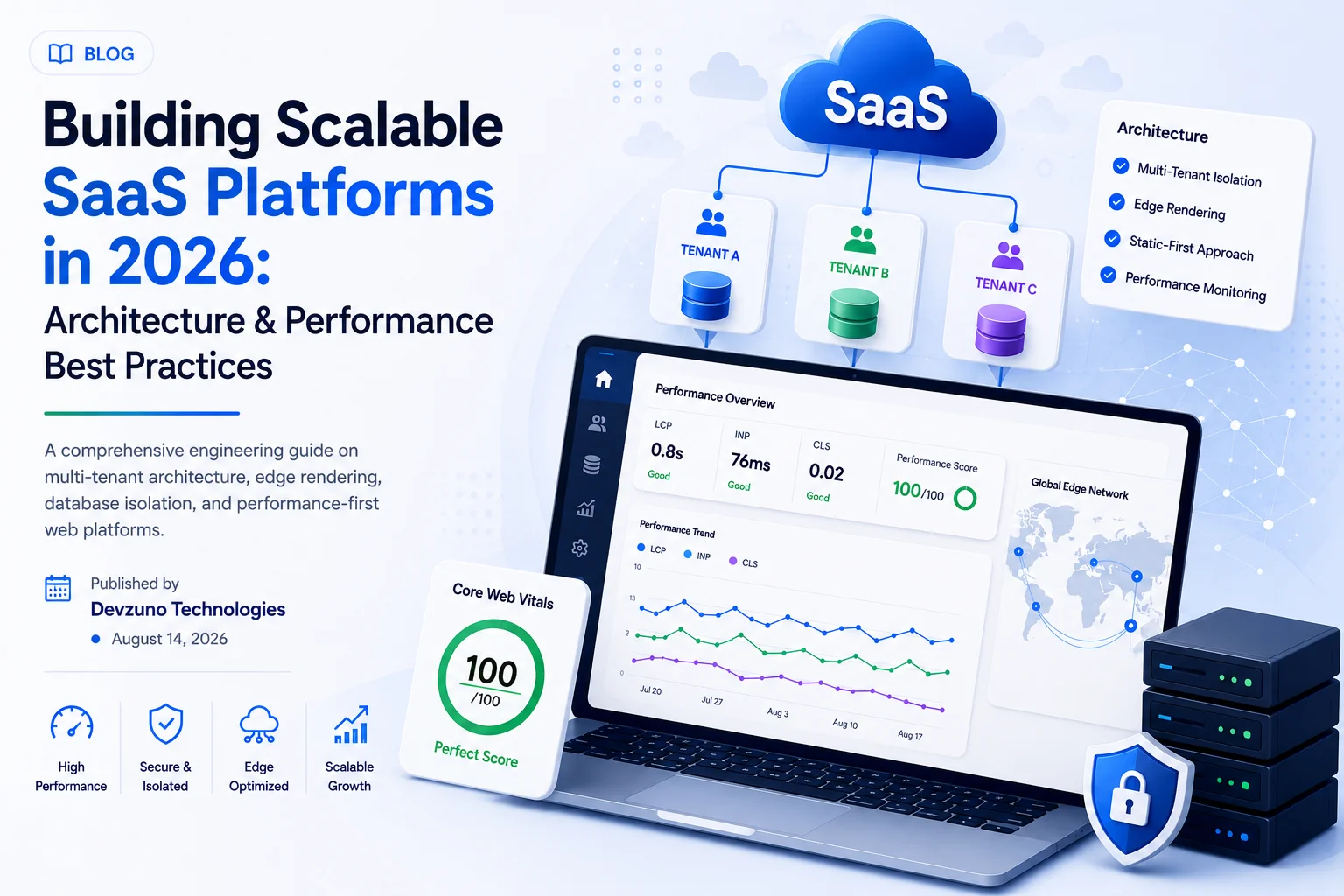
Building a Software-as-a-Service (SaaS) platform today requires a fundamental shift from traditional monolithic design toward performance-first, multi-tenant architectures. As modern user expectations demand sub-second page loads and instantaneous interactions, engineering teams must evaluate every layer of their software stack—from edge rendering and database isolation to API gateways and subscription microservices.
1. Multi-Tenant Data Isolation Strategy
When designing scalable SaaS platforms, choosing the right tenant data isolation model is critical for performance, security compliance, and infrastructure costs:
┌─────────────────────────────────────────────────────────────────────────────┐
│                      SaaS Multi-Tenancy Architecture                        │
└─────────────────────────────────────────────────────────────────────────────┘

  Model 1: Logical Isolation                Model 2: Physical Isolation
  ┌─────────────────────────────┐           ┌──────────────┐  ┌──────────────┐
  │ Shared DB (Row-Level Sec)   │           │ Tenant A DB  │  │ Tenant B DB  │
  │ Tenant ID column per table  │           │ Isolated Pool│  │ Isolated Pool│
└─────────────────────────────┘ └──────────────┘ └──────────────┘- Logical Isolation (Shared Database, Shared Schema): Cost-efficient and easy to maintain for SMB SaaS applications. Data is isolated logically using
tenant_idcolumns paired with PostgreSQL Row-Level Security (RLS) policies. - Schema-Per-Tenant Isolation: Each tenant receives a dedicated PostgreSQL schema inside a shared database cluster. This balances strict security isolation with manageable database management costs.
- Physical Isolation (Database-per-Tenant): Essential for high-security enterprise SaaS environments where data compliance (HIPAA, SOC2, GDPR) requires absolute physical boundary enforcement and custom database encryption keys.
2. Static-First Islands Architecture (Astro 5 + React 19)
By leveraging Astro 5 static site generation combined with selective React 19 Island Hydration, SaaS marketing portals and customer dashboards achieve near-zero client-side JavaScript execution until explicit user interactions occur.
Key Benefits:
- Core Web Vitals: Perfect 100/100 Lighthouse performance scores across Mobile and Desktop viewports.
- Cost Efficiency: Serving pre-rendered HTML and CSS directly via global edge networks (Vercel Edge / Cloudflare Workers) drastically lowers origin server overhead.
- Topical SEO Authority: Search engines easily index fully pre-rendered HTML content without waiting for client-side JavaScript rendering cycles.
3. High-Performance SaaS Technology Stack
| Architecture Layer | Recommended Production Stack | Enterprise Value |
|---|---|---|
| Frontend Framework | Astro 5 + React 19 / Tailwind CSS | Instant page load, zero JS payload overhead |
| Edge & CDN | Vercel Edge / Cloudflare | Global sub-50ms latency response times |
| Primary Database | PostgreSQL + Prisma / Drizzle ORM | ACID compliance, Row-Level Security |
| Cache & Queue Layer | Redis + Upstash / BullMQ | Real-time session management & background jobs |
| Authentication & AuthZ | Clerk / Auth0 / Supabase Auth | Multi-factor auth, SAML SSO, RBAC roles |
| Billing & Payments | Stripe / Razorpay (India local UPI support) | Automated subscription lifecycle management |
4. API Design & Edge Rate Limiting
Scalable SaaS applications require robust protection against API abuse, noisy neighbor workloads, and DDoS vectors:
- Redis-Backed Rate Limiting: Implementing token bucket or sliding window rate limiters per tenant tier (e.g., Free Tier: 60 req/min, Enterprise: 5000 req/min).
- GraphQL / REST Federation: Unifying microservices under a high-performance GraphQL schema or REST edge gateway ensures client applications fetch only the exact data payloads required.
- Webhook Reliability: Asynchronous event handlers powered by background workers (BullMQ / AWS SQS) guarantee payment and integration events are processed reliably with automated retry policies.
5. Security & SOC2 Compliance Foundations
Enterprise B2B clients demand strict security posture before committing to SaaS software contracts:
- Data Encryption: Mandatory AES-256 encryption at rest for database volumes and TLS 1.3 encryption in transit.
- Audit Logging: Comprehensive activity ledgers tracking administrative actions, user logins, data exports, and permission changes.
- Role-Based Access Control (RBAC): Fine-grained permissions allowing SaaS org owners to configure custom administrative, manager, and read-only roles.
6. How Devzuno Technologies Engineers Scalable SaaS Platforms
At Devzuno Technologies, we build end-to-end B2B SaaS platforms, custom cloud applications, and B2C digital products. Our engineering methodology focuses on clean modular code, automated CI/CD deployment pipelines, scalable database schemas, and intuitive user experiences.
Whether you are launching a new SaaS startup or scaling an existing software platform in India (Lucknow, Sonbhadra, Delhi-NCR) or globally, our software architects deliver turn-key SaaS platforms engineered for high throughput.
Frequently Asked Questions
Q1: What is the best database choice for a multi-tenant B2B SaaS app?
PostgreSQL combined with Row-Level Security (RLS) or Schema-per-Tenant isolation is currently the industry gold standard for B2B SaaS platforms. It delivers strong transactional guarantees, high index performance, and smooth horizontal scaling via connection pooling (e.g., PgBouncer).
Q2: How do you handle local Indian payment gateways (UPI) alongside global Stripe billing?
We build unified payment abstraction layers that route Indian subscriptions through Razorpay / Cashfree (for UPI, Netbanking, and domestic credit cards) while seamlessly delegating international client subscriptions to Stripe.
Q3: How long does it take to build a Production-MVP SaaS platform?
A typical SaaS Minimum Viable Product (MVP)—complete with multi-tenant auth, role-based dashboards, database schemas, and billing integration—takes 6 to 10 weeks of sprint development.
Ready to Build or Scale Your SaaS Platform?
Partner with Devzuno Technologies for world-class SaaS software engineering and cloud architecture.