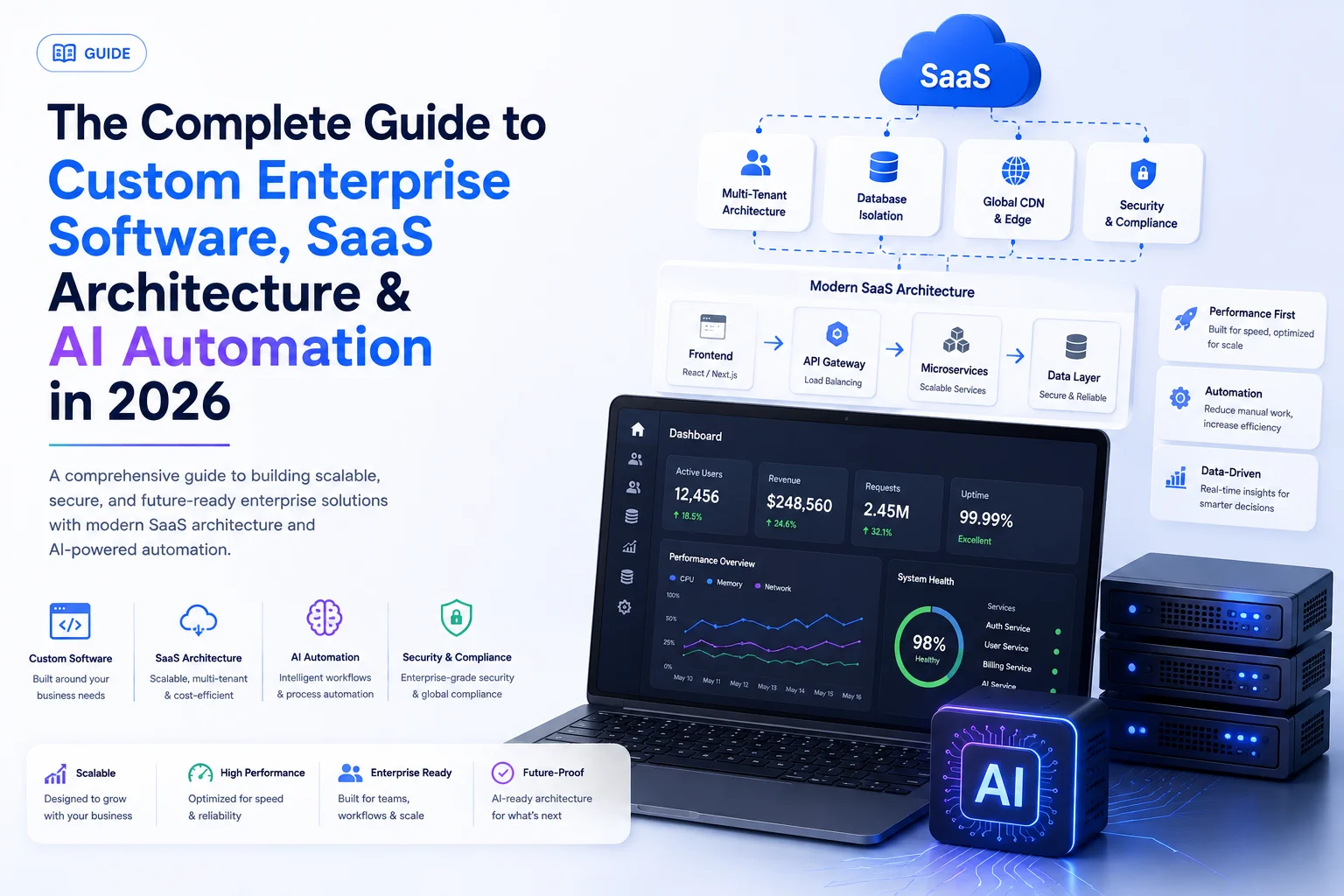
In the modern digital economy, enterprise software has transitioned from being an administrative back-office cost center to the core driver of operational velocity, competitive differentiation, and scalable revenue growth. Organizations across global markets and regional business hubs like Sonbhadra and Lucknow face a critical strategic decision: rely on generic Commercial Off-The-Shelf (COTS) platforms or engineer tailored custom software platforms built around exact operational workflows.
This comprehensive engineering guide explores the architectural principles, trade-offs, tech stacks, data isolation patterns, Core Web Vitals benchmarks, cross-platform mobile sync protocols, cybersecurity frameworks, deployment automation, and AI automation strategies required to build enterprise software, multi-tenant SaaS products, and autonomous AI automation pipelines in 2026.
1. Direct Answer: Custom Software vs. Off-the-Shelf Systems
When evaluating software investments, executive teams and CTOs frequently ask whether custom software development delivers higher Return on Investment (ROI) compared to off-the-shelf subscription SaaS platforms or generic enterprise resource planning (ERP) packages.
Direct Answer: Custom software delivers significantly higher long-term ROI for organizations with unique operational workflows, proprietary data compliance rules, or complex integration requirements. While generic COTS software offers lower initial deployment friction, it introduces ongoing per-user licensing fees, rigid workflow constraints, feature bloat, and zero IP ownership. Custom software requires an upfront capital investment but yields 100% intellectual property ownership, zero recurring per-user licensing costs, total architectural control, sub-second query performance, and seamless integration with existing business infrastructure.
Financial TCO Comparison: 3-Year Outlook
To understand the financial dynamics, compare the 3-Year Total Cost of Ownership (TCO) between a typical commercial SaaS tool charging $35/user/month for a 150-person enterprise versus a custom-engineered enterprise application:
- Commercial SaaS Software (150 Users): $35 × 150 users × 36 months = $189,000 USD (plus recurring price hikes, per-module add-ons, and integration fees with zero asset ownership).
- Custom Enterprise Software: Fixed initial engineering investment + minimal cloud hosting costs = Complete IP ownership, customized workflow automation, and zero incremental cost as your user base expands to 500+ employees.
2. Decoding Custom Enterprise Software Engineering
Custom enterprise software represents digital systems specifically engineered to match the exact procedures, data schemas, security protocols, and operational demands of a specific organization. Unlike generic tools that force businesses to alter their internal operations to match rigid software templates, custom enterprise applications adapt entirely to the business logic.
Key Pillars of Modern Enterprise Software Architecture
- Modular Domain-Driven Design (DDD): Enterprise platforms decompose complex business domains into decoupled microservices or modular monoliths, isolating critical capabilities such as inventory management, accounting, customer relationship management (CRM), and supply chain logistics.
- Strict Data Ownership & Sovereignty: Organizations retain absolute ownership of customer records, transaction logs, and operational telemetry without exposing sensitive data to third-party vendor lock-in or licensing policy shifts.
- Enterprise Role-Based Access Control (RBAC): Granular permission hierarchies ensure that employees, department managers, field operators, and external auditors access only authorized data resources.
- Seamless Third-Party API Integrations: Native connectors connect enterprise software to payment gateways (Razorpay, Stripe), communication channels (WhatsApp Business API, SMS, Email), cloud storage, and legacy hardware databases.
Row-Level Security vs. Application Middleware RBAC
When enforcing security permissions across enterprise databases, software architects evaluate two primary access control patterns:
- PostgreSQL Row-Level Security (RLS): Database-level security policies enforced directly at the SQL layer, preventing unauthorized queries even if application middleware contains bugs.
- Application Middleware Permission Checks: Granular API route guards evaluated during application runtime, allowing dynamic context-aware permissions based on user session state.
To learn more about tailored business tools, explore Devzuno’s Custom Software & ERP Development Services and our Custom Business Software Solutions.
3. Architecting Scalable Multi-Tenant SaaS Platforms
Building a successful Software-as-a-Service (SaaS) platform requires a robust multi-tenant architecture capable of serving thousands of independent organizations (tenants) from a unified cloud codebase while guaranteeing strict data isolation, high availability, and sub-second query performance.
Multi-Tenant Database Isolation Strategies
Selecting the right database architecture is one of the most critical decisions when building SaaS products:
| Database Architecture Strategy | Isolation Level | Maintenance Complexity | Cost Efficiency | Recommended Use Case |
|---|---|---|---|---|
| Shared Database, Shared Schema | Row-Level Isolation (Tenant ID filtering) | Low | Maximum | Early-stage B2B SaaS platforms & high-volume consumer apps |
| Shared Database, Separate Schemas | Schema-Level Isolation | Moderate | High | Mid-market B2B SaaS platforms requiring schema customizations |
| Database-per-Tenant | Physical / Instance Isolation | High | Moderate / Enterprise | Enterprise SaaS requiring HIPAA/GDPR compliance & custom DB encryption |
Core SaaS Platform Modules Engineered by Devzuno
When engineering cloud SaaS solutions, Devzuno implements core foundational modules:
- Unified Identity & JWT Auth: Stateless authentication powered by JSON Web Tokens (JWT), OAuth2, and multi-factor authentication (MFA) with multi-tenant workspace switching.
- Automated Metered & Recurring Billing: Subscriptions, tier upgrades, proration logic, and automated invoice generation integrated with global payment processors.
- Tenant Onboarding & Subdomain Routing: Dynamic tenant provisioning allowing organizations to access custom subdomains (
tenant.yourdomain.com) or custom CNAME domains. - Rate Limiting & Tenant Resource Throttling: Distributed Redis rate limiters preventing noisy-neighbor issues from degrading system performance for other tenant organizations.
Tenant Isolation Code Pattern Example
Below is a conceptual Node.js/TypeScript middleware pattern demonstrating row-level tenant context injection:
// Tenant Context Injection Middleware
export async function tenantContextMiddleware(req: Request, res: Response, next: NextFunction) {
  const tenantHost = req.headers['x-tenant-id'] || extractSubdomain(req.hostname);

  if (!tenantHost) {
    return res.status(400).json({ error: 'Missing tenant identifier' });
  }

  const tenant = await db.tenants.findUnique({ where: { slug: tenantHost } });
  if (!tenant || !tenant.isActive) {
    return res.status(403).json({ error: 'Invalid or suspended tenant account' });
  }

  // Attach tenant context to request scope
  req.tenant = tenant;
  next();
}
Explore Devzuno’s specialized SaaS Development Services and SaaS Platforms Solutions.
4. Next-Generation Web Development & Performance Engineering
A business website or enterprise web application serves as the primary digital interface for clients, partners, and employees. Slow load times, sluggish interactivity, and poor mobile responsiveness directly degrade user retention, conversion rates, and Google search rankings.
Core Web Vitals Optimization Benchmarks
Devzuno engineers web applications to pass strict Google Core Web Vitals thresholds:
- Largest Contentful Paint (LCP): Under 1.8 seconds by pre-loading hero assets and optimizing WebP/AVIF image formats.
- Interaction to Next Paint (INP): Under 50 milliseconds by eliminating main-thread JavaScript blocking.
- Cumulative Layout Shift (CLS): Zero (0.00) by reserving exact container layout dimensions for dynamic elements.
Modern Web Stack: Astro, React & Island Architecture
Modern web development has moved away from heavy client-side JavaScript monoliths toward hybrid architectures. Devzuno leverages Astro, React, and TypeScript to achieve optimal performance:
- Zero-JavaScript by Default: Static content pages compile into pure static HTML, eliminating unnecessary client-side JS execution.
- Selective Hydration (Island Architecture): Interactive elements (e.g., dynamic lead forms, interactive dashboards, search filters) hydrate independently without blocking the main browser UI thread.
- Sub-Second Time to First Byte (TTFB): Global edge deployment via Vercel and Cloudflare ensures sub-100ms response times worldwide.
SEO & Technical Visibility Best Practices
Every production web application must embody technical SEO standards from day one:
- Semantic HTML5 Hierarchy: Enforcing single
<h1 >page titles, structured<h2>and<h3>section headings, uniqueidattributes, and accessibility ARIA roles. - Self-Referencing Canonical URLs: Eliminating duplicate content penalties across staging, preview, and production environments.
- Rich Schema.org JSON-LD Data: Embedding structured
Organization,WebSite,Service, andArticleschemas to power Google Rich Snippets and AI Search Overviews (LLM Search).
For high-performance web platforms, check out Devzuno’s Web Development Services and Web Application Development.
5. Cross-Platform Mobile App Engineering (iOS & Android)
Mobile applications are essential touchpoints for field operations, customer engagement, real-time alerts, and service management. Building separate native iOS (Swift) and Android (Kotlin) codebases doubles development costs and maintenance overhead.
Cross-Platform Architecture: React Native & Flutter
Devzuno utilizes modern cross-platform frameworks to deliver native 60fps performance across iOS and Android from a single unified codebase:
- Native UI Components: Direct compilation to native platform widgets ensures smooth transitions, gesture navigation, and native platform aesthetics.
- Offline-First Synchronization: Local SQLite / WatermelonDB storage enables field workers to record data without internet connectivity, automatically syncing background queues once a network connection is re-established.
- Hardware Integration: Native bridge integration for camera barcode scanning, Bluetooth printing, GPS location tracking, and push notifications (Firebase Cloud Messaging).
- Secure Key Storage: Encrypted biometric storage (FaceID / Fingerprint) and secure token caching for enterprise mobile security compliance.
Offline Sync Protocol: Conflict Resolution Strategies
When multiple field devices update records offline, mobile synchronization engines must resolve data conflicts seamlessly:
- Last-Write-Wins (LWW): Timestamp-based overwrite suitable for independent record updates.
- Conflict-Free Replicated Data Types (CRDTs): Mathematical data structures that automatically merge concurrent state edits without server locking.
- Vector Clocks: Causal tracking used in high-concurrency enterprise inventory platforms.
Discover Devzuno’s mobile capabilities via our Mobile App Development Services.
6. Harnessing Agentic AI & Autonomous Workflow Automation
Artificial Intelligence has advanced far beyond basic conversational chatbots. Modern enterprise software leverages Agentic AI—autonomous systems capable of evaluating complex unstructured data, making multi-step decisions, executing background tasks, and continuously optimizing business workflows.
Enterprise AI Use Cases Developed by Devzuno
- Automated Document Intelligence & PDF Parsing: Extracting structured line items, tax IDs, invoice totals, and payment terms from unstructured PDF scans, purchase orders, and legal contracts with human-in-the-loop review triggers.
- Intelligent Support & Ticket Routing: Analyzing sentiment, urgency, and technical keywords from incoming customer inquiries to automatically dispatch issues to specialized engineering tier teams.
- Predictive Inventory & Logistics Optimization: Evaluating historical sales cycles, seasonal demand fluctuations, and supplier lead times to automate purchase orders and route optimization.
- Custom LLM Fine-Tuning & RAG Pipelines: Building Retrieval-Augmented Generation (RAG) knowledge bases over private corporate document repositories, ensuring internal teams query company knowledge bases securely without data leaking to public AI models.
Agentic Execution Loop Blueprint
[ Input: Unstructured Document / Event ] ➔ [ Agent Reasoning & LLM Evaluation ] ➔ [ Action Execution: API Call / DB Write ] ➔ [ Validation & Human Feedback Loop ]Learn how AI transforms business operations through Devzuno’s AI & Automation Services and AI Automation Solutions.
7. Architectural Comparison: Monolith vs. Microservices vs. Serverless
Choosing the structural paradigm for custom software impacts deployment complexity, infrastructure spend, and team velocity:
| Architectural Pattern | Scalability | Deployment Complexity | Infrastructure Cost | Best Suited For |
|---|---|---|---|---|
| Modular Monolith | High (Vertical & Horizontal scaling) | Low | Low | Early to mid-stage enterprise platforms & rapid MVP launches |
| Microservices Architecture | Extremely High (Independent service scaling) | High (Kubernetes, service mesh required) | High | Large multi-team enterprises with complex decoupled domains |
| Serverless Functions (FaaS) | Automatic Scaling (Event-driven) | Low to Moderate | Usage-Based Pay-per-Execution | Asynchronous jobs, image processing, webhook listeners, AI tasks |
Devzuno typically recommends starting with a clean Modular Monolith architecture for new enterprise projects. This avoids prematurely splitting codebases into complex microservices while maintaining clean boundary abstractions that can be easily split as traffic scales.
8. Case Study Spotlight: How Devzuno Engineered School Thinker OS
To illustrate real-world software architecture in action, consider School Thinker OS—Devzuno’s proprietary, next-generation school operating system designed for educational institutions across Uttar Pradesh and India.
Operational Challenges Solved by School Thinker OS
Educational institutions traditional struggle with fragmented legacy software: separate tools for fee collection, student attendance, report card generation, staff payroll, and parent communication. This fragmentation leads to manual data re-entry, billing errors, delayed fee collection, and poor parent visibility.
Architectural Blueprint of School Thinker OS
Devzuno engineered School Thinker OS as a unified, cloud-native platform featuring:
- Automated Fee Finance Engine: Multi-tier fee structuring, late-fee calculation logic, instant digital receipts, automated SMS/WhatsApp payment reminders, and online payment gateway integration.
- Real-Time Attendance & Parent Alert System: Biometric and mobile attendance tracking with instant automated WhatsApp alerts sent to parents upon student arrival or absence.
- Academic & Examination Portal: Gradebook management, automated CBSE/ICSE report card compilation, tabulations, and digital student performance analytics.
- Multi-Role RBAC: Dedicated portals for School Management, Principals, Teachers, Accountants, Transport Drivers, and Parents.
Explore the complete product breakdown on the official School Thinker Product Page and read the detailed School Thinker Case Study.
9. Enterprise Cybersecurity & Data Compliance Standards
Building mission-critical enterprise software requires embedding security mechanisms into the application layer from the initial commit:
- Data Encryption at Rest & in Transit: AES-256 encryption for database storage and TLS 1.3 for all REST and GraphQL API communication.
- OWASP Top 10 Safeguards: Automated sanitization preventing SQL injection, Cross-Site Scripting (XSS), Cross-Site Request Forgery (CSRF), and broken object-level authorization (BOLA).
- Comprehensive Audit Logs: Immutable event logging tracking every administrative action, data export, and permission modification for compliance verification.
- Automated CI/CD Vulnerability Scanning: GitHub Actions workflows running automated SAST (Static Application Security Testing) and dependency vulnerability audits on every pull request.
10. Development Process & Calculating Software Investment
Successful software delivery requires a disciplined, transparent engineering process to eliminate project risk, prevent scope creep, and ensure on-time delivery.
Devzuno’s 4-Phase Software Engineering Framework
- Phase 1: Discovery & Product Architecture: Detailed requirements gathering, wireframing, database schema design, API contract definition, and fixed-scope milestone roadmap creation.
- Phase 2: Agile Sprint Development: Bi-weekly development sprints with working software demos, continuous integration (CI), and transparent progress tracking via GitHub / Jira.
- Phase 3: Quality Verification & Security Audit: Comprehensive unit testing, integration testing, end-to-end (E2E) automated browser verification, cross-device mobile testing, and vulnerability auditing.
- Phase 4: Production Cloud Deployment & Support: Seamless zero-downtime deployment, staging-to-production migration, automated database backup configuration, and continuous post-launch maintenance.
Factors Influencing Custom Software Costs in India
Software development costs depend directly on technical complexity, integrations, scale, and compliance requirements:
- Scope & User Roles: A single-role administrative tool requires significantly less frontend engineering than a multi-tenant platform with 5 distinct user role access levels.
- Third-Party API Integrations: Connecting software to custom legacy ERPs, payment gateways, or hardware interfaces increases integration testing scope.
- Security & Compliance: High-security financial, healthcare, or enterprise compliance standards necessitate additional encryption, auditing logs, and penetration testing.
Conclusion: Partnering with Devzuno Technologies
Building software is not merely about writing code—it is about engineering reliable, maintainable digital products that eliminate operational friction and unlock new business growth. Devzuno Technologies brings senior engineering craft, transparent communication, and modern tech stacks to every engagement.
Whether you are a growing business in Sonbhadra, an enterprise in Lucknow, or a startup anywhere across India, our engineering team is ready to turn your vision into production software.
- Explore our full range of Software Services
- Review our Solutions Portfolio
- Browse our industry focus in Industries Served
- Read expert technical articles in Devzuno Insights
- Discover our background on the About Devzuno page
Ready to start your next software project? Contact Devzuno Technologies today for a direct technical consultation with our engineering architects.