
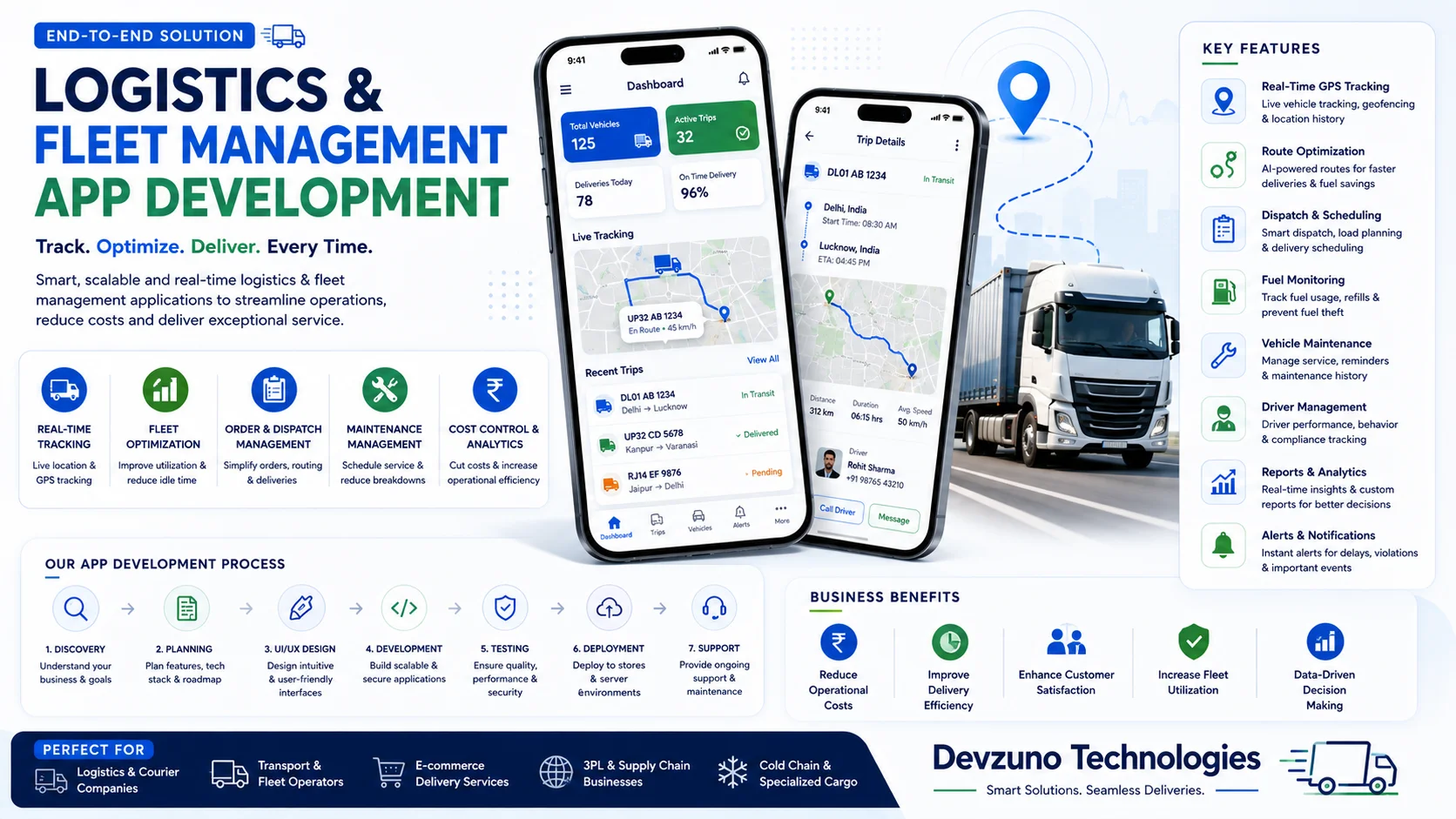
In 2026, the logistics, freight transport, and last-mile delivery sector across India is undergoing rapid modernization. With national infrastructure expanding and businesses demanding sub-hour delivery SLAs, fleet operators, 3PL logistics providers, and trucking enterprises can no longer rely on manual phone calls, paper logbooks, or standalone GPS hardware.
Building a custom logistics and fleet management software ecosystem—comprising a Driver Mobile App, a Customer Shipment Tracking Portal, and an Admin Dispatch Control Tower—allows logistics enterprises to digitize operations. Real-time telemetry, automated route optimization, and digital proof of delivery (e-POD) directly lower operational costs while improving fleet utilization.
In this comprehensive engineering guide, we compare custom logistics platforms against generic GPS tracking software, examine high-concurrency WebSocket architecture, detail AI route optimization algorithms, explore cold chain IoT sensors, provide an itemized cost breakdown in Indian Rupees (₹) and USD ($), and explain how FASTag and E-Way Bill API integrations streamline freight workflows.
1. Generic GPS Hardware vs. Integrated Custom Logistics Platform
Many transport companies start by installing basic GPS trackers in vehicles. However, standalone trackers only show latitude and longitude on a map—they do not automate dispatch, calculate trip profit margins, or digitize driver settlements.
Below is a comparison between standalone GPS trackers and a custom logistics software platform:
| Operational Metric | Standalone GPS Hardware Trackers | Custom Integrated Logistics Platform (Devzuno Architecture) |
|---|---|---|
| Operational Visibility | Vehicle location dots on a map only | Full Order Lifecycle (Dispatch -> Loading -> Route -> e-POD -> Billing) |
| Driver Workflow | Manual phone calls for trip status | Dedicated Driver App (Digital job assignments & e-signatures) |
| Fuel & Route Optimization | Static Google Maps routes | AI Dynamic Route Optimization (Saves 18% – 25% on fuel) |
| Proof of Delivery (POD) | Paper receipts (High risk of loss) | Digital e-POD (Geofenced photo & customer sign-off) |
| FASTag & Toll Reconciliation | Manual receipt collection | Automated FASTag API Sync (Instant toll cost matching) |
| Data Ownership & Analytics | Locked in vendor tracking portal | 100% Full Ownership of Logistics Database & Telematics |
Why 3PL Logistics Enterprises Invest in Custom Software
- Substantial Fuel Cost Reduction: AI-driven route optimization algorithms recalculate delivery sequences based on real-time traffic conditions, vehicle load weight, and delivery time windows, slashing monthly fuel expenses by 18% to 25%.
- Zero Paperwork Delays: Digital proof-of-delivery (e-POD) automatically triggers customer invoices the second goods are unloaded, accelerating cash flow cycles.
- Complete Fleet Maintenance Visibility: OBD-II telematics data monitors engine diagnostics, tire pressure, and driver behavior (sudden braking, idling), preventing costly roadside breakdowns.
2. Core Modules for an End-to-End Fleet Management Ecosystem
A complete logistics software ecosystem connects three core interfaces:
A. Driver Mobile App (iOS & Android - Flutter)
- Digital Trip Job Board: Drivers receive real-time job dispatch alerts with pick-up locations, cargo details, and delivery window SLAs.
- Turn-by-Turn Truck Navigation: Specialized commercial vehicle navigation displaying height, weight, and toll restrictions.
- Electronic Proof of Delivery (e-POD): Capture customer digital signatures, cargo photos, and timestamps linked to geofenced GPS coordinates.
- Expense Logbook & Fuel Receipts: Drivers upload fuel bills and toll receipts directly via camera scan for instant admin reimbursement verification.
B. Customer Shipment Tracking Portal
- Real-Time Shipment Tracking: Customers track their cargo location on a live interactive map with accurate estimated time of arrival (ETA) predictions.
- Automated Status Notifications: SMS and WhatsApp status updates (Order Dispatched -> In Transit -> Out for Delivery -> Delivered).
- Digital Invoice & POD Download: Instant access to signed delivery receipts and GST tax invoices.
C. Admin Dispatch & Control Tower Dashboard
- Live Fleet Map & Dispatch Control: Monitor hundreds of active trucks simultaneously with color-coded status indicators (Moving, Idling, Stopped, Delayed).
- Automated Order-to-Vehicle Matching: Algorithms match pending shipment loads with the nearest available truck based on capacity (Tonnage/Cubic Feet).
- FASTag Toll & E-Way Bill API Integration: Automatically fetch toll transaction logs from National Payments Corporation of India (NPCI) FASTag APIs and validate government E-Way Bill compliance.
3. High-Concurrency System Architecture: Processing 10,000+ Location Pings/Sec
Managing a fleet requires server infrastructure capable of processing high-frequency GPS telemetry data without database slowdowns:
[Vehicle GPS Hardware / Driver App]
                 │
                 ▼ (Persistent WebSocket / MQTT Streams)
    [API Load Balancer & Rate Limiter]
                 │
  ┌──────────────┴──────────────┐
  ▼                             ▼
[High-Concurrency Go Ingestion Engine]
  │                             │
  ▼                             ▼
[Redis In-Memory RAM Cache] -> [RabbitMQ Stream]
  │                             │
  ├─────────────────────────────┴─────────────────────────────┐
  ▼                                                           ▼
[PostgreSQL + PostGIS (Spatial Routing DB)]     [InfluxDB (Time-Series Telematics)]
Technical Component Breakdown
- Mobile Frontend: Built using Flutter (Dart) for cross-platform iOS and Android apps, delivering 60-120 FPS fluid performance across budget Android smartphones used by drivers.
- High-Concurrency Ingestion Server: Go (Golang) microservices process thousands of incoming location pings per second with minimal CPU and memory overhead.
- Stream Queue & Cache: Redis holds the latest vehicle coordinates in RAM for instant web rendering, while RabbitMQ queues location streams for time-series logging.
- Spatial & Telematics Storage: PostgreSQL with PostGIS extension handles spatial route queries, while InfluxDB stores historical speed, engine RPM, and fuel level sensor data.
4. AI Dynamic Route Optimization & Fuel Savings Engine
Fuel accounts for nearly 40% of total fleet operational expenses. Integrating AI route planning algorithms transforms fleet profitability:
- Multi-Stop Route Optimization: Solving the Vehicle Routing Problem with Time Windows (VRPTW) to determine the most fuel-efficient sequence for up to 50 delivery stops per vehicle.
- Dynamic Traffic Rerouting: Automatically rerouting drivers around urban congestion or highway accidents in real-time.
- Driver Behavior Scoring: Tracking excessive idling, over-speeding, and harsh braking events, scoring drivers to reward fuel-efficient driving habits.
5. Cold Chain Temperature & Humidity Sensor Telematics
For pharmaceutical, dairy, frozen food, and perishable cargo logistics, maintaining unbroken cold chain temperature compliance is mandatory:
- BLE Temperature Sensor Sync: Wireless Bluetooth Low Energy (BLE) sensors installed inside refrigerated cargo containers stream real-time temperature logs to the Driver App and Admin Dashboard.
- Automated Thermal Breach Alerts: Instant SMS and push notification alerts triggered if container temperatures drift outside the required range (e.g., 2°C to 8°C).
- Compliance Audit Reports: Downloadable PDF temperature logs for regulatory compliance verification upon cargo delivery.
6. Cost Breakdown for Logistics & Fleet App Development in India (2026)
Custom logistics software pricing depends on the number of mobile apps, mapping complexity, and third-party API integrations. Below is an itemized budget guide for Indian transport enterprises in 2026:
| Logistics Software Tier | Capability Scope & Deliverables | Estimated Cost (INR - ₹) | Equivalent USD ($) | Delivery Timeline |
|---|---|---|---|---|
| Starter Transport Tracking App | Driver App, Customer Map Tracking, Order Status, Basic Admin Dashboard, WhatsApp Sharing | ₹3 Lakhs – ₹6.5 Lakhs | $3,600 – $7,800 | 6 – 10 Weeks |
| Full Fleet Management ERP | Driver App, Customer Portal, Admin Dispatch Tower, AI Route Optimization, e-POD, FASTag Sync | ₹6.5 Lakhs – ₹14 Lakhs | $7,800 – $16,800 | 10 – 16 Weeks |
| Enterprise 3PL / Supply Chain Ecosystem | Telematics OBD-II Engine, Multi-Depot Optimization, E-Way Bill API, Automated Driver Payouts | ₹14 Lakhs – ₹32 Lakhs+ | $16,800 – $38,000+ | 16 – 26+ Weeks |
Itemized Module Cost Matrix
For businesses planning a phased development rollout:
- UI/UX Wireframing & System Architecture: ₹45,000 – ₹90,000
- Driver Mobile App (Flutter iOS + Android): ₹1.5 Lakhs – ₹3.8 Lakhs
- Customer Shipment Tracking Portal: ₹80,000 – ₹2.2 Lakhs
- Admin Dispatch Control Tower (Web App): ₹1.2 Lakhs – ₹3.5 Lakhs
- High-Concurrency Go Engine & Mapbox API Integration: ₹90,000 – ₹2.8 Lakhs
- FASTag, E-Way Bill & Cloud Telephony APIs: ₹40,000 – ₹85,000
7. Driver Settlement, Fuel Allowances & Backhaul Freight Matching
Automating driver payouts and eliminating empty return trips (deadhead miles) directly impacts bottom-line profit margins:
- Automated Trip Settlement Ledger: Calculate driver fixed allowances, per-kilometer rates, detention charges, and approved fuel reimbursements automatically upon trip completion.
- Backhaul Freight Matching Engine: Algorithms match empty return trucks returning from destination cities with available local cargo loads, eliminating unproductive empty runs.
8. Step-by-Step Logistics Software Development Lifecycle
At Devzuno Technologies, we follow a disciplined 5-stage software engineering process to build robust logistics platforms:
[Phase 1: Workflow Discovery] --> Mapping Fleet Routes, Depot Locations & Driver Tasks
[Phase 2: Database & API Setup] --> Architecting PostGIS Spatial DB & WebSocket Engine
[Phase 3: Flutter App Build]     --> Engineering Cross-Platform iOS & Android Apps
[Phase 4: Load & Stress Testing] --> Simulating 10,000 Concurrent GPS Location Streams
[Phase 5: Deployment & Training] --> Cloud Server Setup, Store Launch & Staff Onboarding
9. Frequently Asked Questions (FAQ) for Fleet Operators
Q1. How long does it take to develop a custom logistics and fleet management app?
A Starter transport tracking app takes 6 to 10 weeks to develop and publish. A comprehensive fleet management ERP featuring AI route optimization, FASTag toll sync, and an Admin Dispatch Control Tower requires 10 to 16 weeks.
Q2. Can the app work with existing GPS hardware installed in our trucks?
Yes. Our backend supports universal telemetry ingestion protocols (TCP/UDP/MQTT). We can integrate data streams from your existing AIS-140 compliant GPS hardware trackers alongside the Driver Mobile App.
Q3. How does offline mode work on the Driver Mobile App?
When drivers travel through remote areas with limited cellular connectivity, the Flutter Driver App stores GPS logs, uploaded fuel receipts, and customer e-signatures locally in an encrypted database (Isar/Hive). Once connectivity is restored, the app automatically syncs all offline data to the cloud servers.
Q4. How does AI route optimization reduce fuel costs?
Our route optimization algorithms evaluate multiple variables simultaneously—including real-time traffic conditions, vehicle load capacity, delivery time windows, and road height/weight restrictions—to generate the shortest, most fuel-efficient delivery route.
Q5. What is the difference between Google Maps and Mapbox for fleet tracking?
While Google Maps is ideal for consumer navigation, Mapbox offers greater flexibility for fleet management—including custom map styling, polygon geofencing, asset tracking, and significantly lower API pricing for high-volume location queries.
Q6. How does FASTag toll API integration prevent driver toll fraud?
Our system pulls official FASTag transaction logs directly from NPCI bank gateways via API, matching toll deductions against the exact time and GPS coordinates of the truck. This eliminates manual driver receipt claims and prevents fraud.
Q7. Will I own full source code and database rights?
Yes. At Devzuno Technologies, you receive 100% full source code ownership, private GitHub repository access, database schemas, and complete intellectual property rights upon project milestone completions.
Q8. What ongoing cloud server infrastructure fees should we expect?
For a fleet of 50 to 200 active vehicles sending real-time location pings, cloud server infrastructure on AWS or DigitalOcean costs between ₹3,000 and ₹9,000 / month.
10. Why Devzuno is the Leading Engineering Partner for Logistics Tech
At Devzuno Technologies, we build high-performance mobile applications, enterprise web portals, and custom software systems designed to streamline complex business operations. Explore our Devzuno Enterprise Software Solutions or learn more about our Full-Stack Custom Development Services.
When you partner with Devzuno for your logistics technology, you get:
- High-Concurrency Engineering: Backend systems engineered in Go and Node.js capable of processing thousands of location streams per second cleanly.
- Cross-Platform Flutter Mastery: Ultra-fast, 60-120 FPS mobile apps for drivers and customers compiled from a single optimized codebase.
- Complete Source Code Ownership: 100% full ownership of GitHub repositories, IP rights, and server access from day one.
- Transparent Milestone Contracts: Clear pricing in Indian Rupees (₹) starting from ₹3 Lakhs with defined milestone deliverables.
Ready to Streamline Your Fleet Operations with Custom Software?
Eliminate manual dispatch friction, reduce monthly fuel expenses, and provide your customers with real-time delivery visibility.
👉 Schedule a Technical Consultation with Devzuno Engineers Today to receive a customized project roadmap for your logistics platform!