
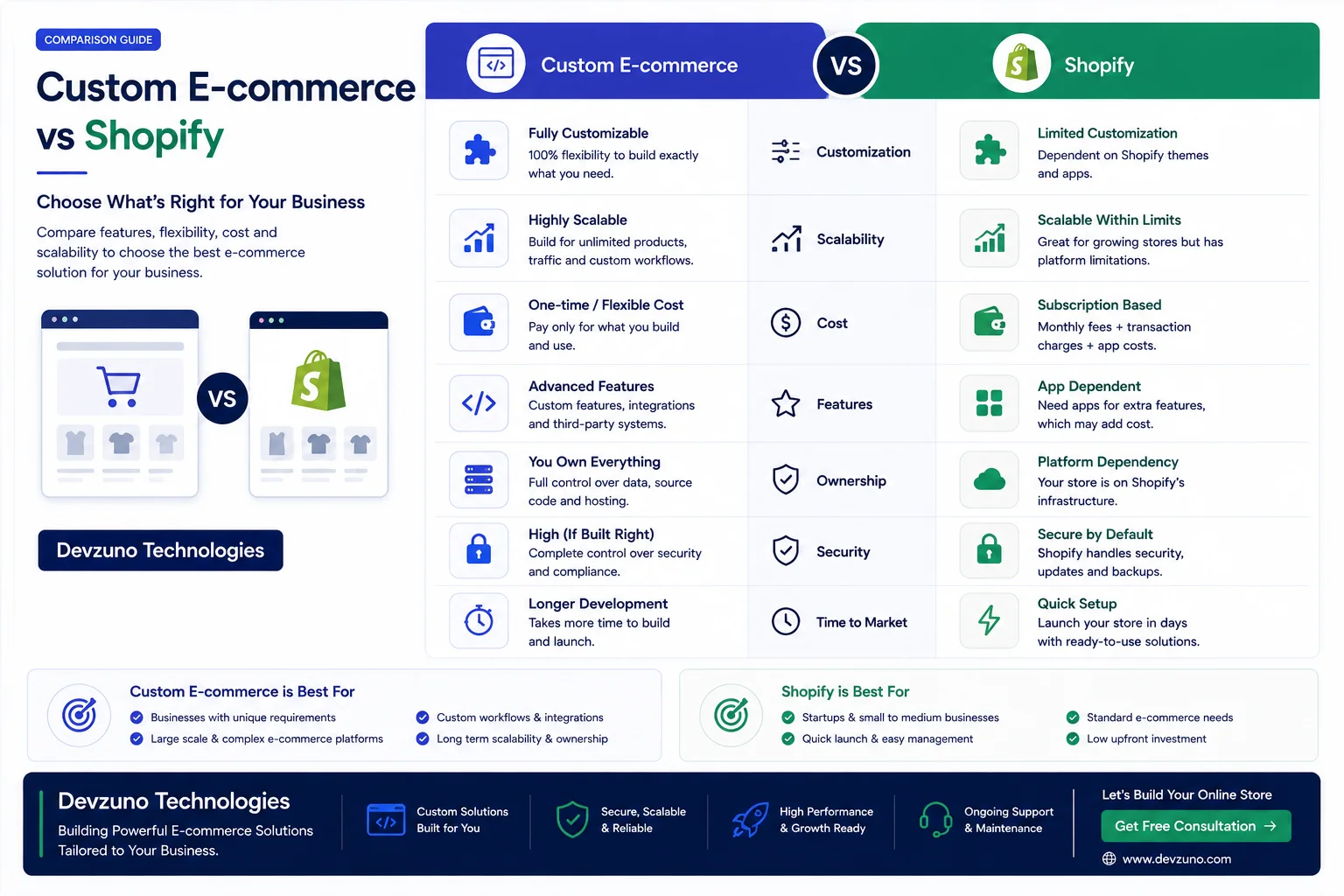
For rapidly growing Direct-to-Consumer (D2C) brands, B2B wholesale distributors, and multi-vendor marketplaces, choosing an e-commerce platform is a foundational business decision.
While SaaS platforms like Shopify and Shopify Plus offer quick setup for early-stage online stores, scaling brands eventually encounter severe architectural limitations: mandatory 0.5%–2.0% transaction fee penalties on non-Shopify payments, rigid checkout customization rules, expensive app subscription stacks, and limited multi-vendor vendor payout logic.
Conversely, a custom-engineered e-commerce platform built by a specialized engineering company like Devzuno Technologies delivers 100% full source code ownership, zero transaction penalties, sub-second vector product catalog search, and bespoke multi-vendor marketplace workflows.
This guide provides an exhaustive financial, technical, and operational comparison between Shopify and Custom E-Commerce Software Engineering.
1. Defining the Core E-Commerce Architectures
Before comparing cost models, it is essential to understand the architectural differences:
Commercial SaaS E-Commerce (Shopify / Shopify Plus)
Shopify is a hosted, closed-source SaaS platform. You build on top of proprietary Liquid template files and closed backend servers. Customizing checkout flows or adding specialized business features requires installing third-party monthly subscription apps or upgrading to Shopify Plus ($2,000+/month).
Custom Headless & Full-Stack E-Commerce Engineering
Custom e-commerce engineering utilizes open-source frameworks (Astro, Next.js, Node.js, PostgreSQL) to build a bespoke storefront and backend engine tailored precisely to your inventory management, pricing tiers, and vendor settlement logic. You own 100% of the intellectual property, database models, and source code.
2. 10-Point Technical & Business Comparison Framework
Below is an exhaustive evaluation comparing Shopify against Custom E-Commerce Platforms:
| Evaluation Criteria | Commercial SaaS (Shopify / Shopify Plus) | Custom E-Commerce Platform (Devzuno) |
|---|---|---|
| Transaction Fee Penalty | 0.5% – 2.0% extra fee unless using Shopify Payments | 0% Transaction Penalty (Direct Merchant Rates) |
| Codebase & IP Ownership | 0% (Hosted closed-source ecosystem) | 100% Full Source Code & IP Ownership |
| Checkout Customization | Locked down (Requires Shopify Plus $2,000/mo) | 100% Fully customizable checkout flows & UI |
| Product Search Speed | Basic keyword matching | Sub-50ms Vector Search (Algolia / Typesense) |
| Multi-Vendor Marketplace Support | Requires expensive third-party plugin extensions | Native Multi-Vendor Seller Dashboards & Payouts |
| App Subscription Stacks | High monthly fees ($500 - $3,000+/mo for apps) | Built-in features (Zero recurring app fees) |
| Database Scalability | Vendor API rate limits & variant caps (100 variants/product) | Unlimited SKUs, dynamic variants, & DB sharding |
| B2B Tiered Pricing & Quotes | Restricted to high-tier enterprise plans | Native custom B2B pricing, credit terms, & RFQs |
| Page Speed & Core Web Vitals | 45 – 70 / 100 Mobile (Slowed by third-party app scripts) | 95 – 100 / 100 Mobile (Astro Zero-JS frontend) |
| Vendor Lock-In Risk | High (Data export restricted to CSV files) | Zero (Complete code and database portability) |
3. Financial Analysis: 3-Year Total Cost of Ownership (TCO)
Many brands select Shopify assuming it is the cheapest option. However, as annual Gross Merchandise Value (GMV) scales past ₹1 Crore, hidden Shopify fees accumulate exponentially.
Financial Case Study: Brand Doing ₹5 Crore Annual Online Sales
       3-YEAR TOTAL E-COMMERCE EXPENDITURE COMPARISON

Cost (INR)
  ▲
  │                                    / [Shopify Plus + App Stack + Fees]
  │                                   /  (Perpetual GMV % + Monthly Apps)
  │                                  /
  │    ┌────────────────────────────/─── [Custom E-Commerce Platform]
  │    │                           /     (One-time Build + Cloud Infra)
  │    │                          /
  └────┴─────────────────────────┴───────────────────────────────► Time (Years)
     Year 1                    Year 2                    Year 3
Option A: Shopify Plus Platform Costs
- Base Subscription: $2,000/month (~₹20.0 Lakhs/year fixed licensing expenditure).
- 0.5% Third-Party Gateway Fee (on ₹5 Cr GMV): ₹2.5 Lakhs/year in perpetual checkout transaction penalties.
- Essential App Stack Subscriptions: (Klaviyo email marketing, Recharge subscription billing, Judge.me reviews, Gorgias support desk, Searchanise vector search) = ₹6.0 Lakhs/year.
- 3-Year Total Shopify Expenditure: ₹85.5 Lakhs.
Option B: Custom E-Commerce Engineering with Devzuno
- Initial Development Cost: ₹12.0 Lakhs (One-time capital investment for total code and IP ownership).
- AWS Cloud Infrastructure & Hosting: ₹1.8 Lakhs/year for elastic auto-scaling cloud servers.
- Annual Maintenance SLA: ₹1.8 Lakhs/year for 24/7 technical monitoring and software updates.
- 3-Year Total Custom Platform Expenditure: ₹22.8 Lakhs.
💡 Financial Verdict:
By Year 2, the cumulative cost of Shopify subscriptions, transaction penalties, and app stack fees far exceeds custom development. Over 3 years, Custom E-Commerce Software saves over ₹62.7 Lakhs, while delivering a 100% owned corporate asset.
4. Headless Commerce Architecture: Decoupling Frontend & Backend
Modern enterprise e-commerce relies on Headless Commerce Architecture, where the frontend presentation layer is completely separated from backend inventory and payment logic:
┌───────────────────────────────────────────────────────────────────────────┐
│                     HEADLESS STOREFRONT LAYER                             │
│       (Astro / Next.js / React / Mobile App / Point of Sale POS)          │
└─────────────────────────────────────┬─────────────────────────────────────┘
                                      │
                                      ▼  (GraphQL / RESTful API Interface)
┌───────────────────────────────────────────────────────────────────────────┐
│                     DECOUPLED HEADLESS COMMERCE CORE                      │
│ (Catalog Service / Cart Service / Order Engine / Multi-Tenant Inventory)  │
└─────────────────────────────────────┬─────────────────────────────────────┘
                                      │
                                      ▼
┌───────────────────────────────────────────────────────────────────────────┐
│                       ENTERPRISE ERP & LOGISTICS ENGINE                   │
│        (SAP / Tally / Unicommerce / Delhivery / Shiprocket APIs)          │
└───────────────────────────────────────────────────────────────────────────┘
Advantages of Headless Commerce:
- Omnichannel Publishing: Serve the exact same product catalog, pricing, and promotion logic simultaneously across Web Storefronts, Mobile Apps, WhatsApp Catalogs, and POS Smart Kiosks.
- Sub-Second Page Loads: Renders ultra-fast static HTML on the edge CDN while fetching real-time cart data asynchronously via GraphQL APIs.
5. High-Converting Custom Checkout & Address Validation Engine
The checkout flow is the most critical conversion bottleneck in e-commerce. Devzuno engineers frictionless custom checkout experiences:
- One-Page Accelerated Checkout: Reducing checkout steps from 4 pages down to a single streamlined step with Google Places API autocomplete for instant address entry.
- Cash on Delivery (COD) Fraud Verification: Automated mobile OTP verification and historical COD refusal risk scoring before approving COD order placement.
- Dynamic Cart Upsells & Cross-Sells: Recommending complementary products based on items currently inside the shopping cart without slowing down page load speeds.
6. Dynamic Promotions Engine & Custom Discount Logic
Standard e-commerce platforms struggle with complex promotional logic. Devzuno builds high-performance rules engines:
- Stackable Coupons & Buy-X-Get-Y (BXGY): Configuring granular promo rules (e.g., Buy 2 Shirts, Get 1 Belt Free; 10% Extra Discount on UPI Payment).
- Tiered Loyalty Program Points: Automated credit of reward points per purchase, redeemable directly as cash discounts on subsequent checkouts.
- Anti-Fraud Coupon Velocity Controls: Enforcing rate limits on promotional code redemptions to prevent automated coupon scraping bots from draining marketing budgets.
7. Customer Review Verification & UGC Engine
Social proof directly dictates online conversion rates. Instead of paying monthly app subscriptions for review plugins:
- Verified Buyer Badge Logic: Authenticating product review submissions directly against completed order records in the database.
- User-Generated Content (UGC) Media Vaults: Allowing customers to upload photos and videos alongside reviews, compressed automatically to WebP format and stored on AWS S3 edge buckets.
8. Automated GST HSN Tax Calculation & Invoicing Module
For businesses operating across India, complying with GST tax rates (5%, 12%, 18%, 28%) across states requires automated tax calculation:
- HSN Code Tax Mapping: Automatically calculating CGST, SGST, or IGST tax splits based on buyer state and product HSN codes.
- Automated B2B GST Invoicing: Generating PDF invoices containing buyer GSTIN numbers for seamless B2B input tax credit (ITC) claims.
9. Subscription Billing Engine & Recurring Orders
For consumable product categories (health supplements, pet food, specialty coffee), subscription billing drives predictable monthly revenue:
- Automated Recurring Billing: Integrating recurring credit card and UPI AutoPay mandates to automatically renew monthly subscription orders.
- Subscriber Customer Portal: Allowing buyers to pause, skip, or modify subscription delivery frequencies easily without needing customer support intervention.
10. B2B E-Commerce & Wholesale Capabilities
B2B wholesale trading requires complex business rules that B2C retail platforms like standard Shopify cannot handle out of the box:
- Customer-Specific Wholesale Pricing Tiers: Configuring custom discounted price lists (Tier A, Tier B, Wholesale Distributor) assigned dynamically upon customer login.
- Minimum Order Quantities (MOQ) & Volume Tiering: Enforcing bulk purchase rules (e.g., Minimum 50 units for Tier 1 pricing; 200 units for Tier 2 pricing).
- Request for Quote (RFQ) Engine: Allowing corporate buyers to submit custom price quote requests directly from their cart, which sales teams can negotiate and approve inside an admin portal.
- Credit Limit & Postpaid Credit Terms: Managing credit lines (e.g., Net 30 / Net 60 payment terms) with automated credit limit validation upon order placement.
11. Multi-Vendor Marketplace Architecture: Seller Portals & Payouts
Engineering a multi-vendor marketplace (like Amazon or Flipkart) where multiple independent sellers list products requires specialized backend architecture:
┌───────────────────────────────────────────────────────────────────────────┐
│                      CUSTOMER FRONTEND (Astro / React)                    │
└─────────────────────────────────────┬─────────────────────────────────────┘
                                      │
                                      ▼
┌───────────────────────────────────────────────────────────────────────────┐
│                    CENTRAL MARKETPLACE ENGINE & API                       │
│    (Order Splitting, Commission Calculation, Automated Ledger Routing)    │
└───────────────────────────┬───────────────────┬───────────────────────────┘
                            │                   │
                            ▼                   ▼
┌──────────────────────────────────┐  ┌──────────────────────────────────┐
│ SELLER PORTAL DASHBOARD          │  │ AUTOMATED PAYOUT ENGINE          │
│ (Inventory, Orders, KYC)         │  │ (Razorpay Route / Cashfree Split)│
└──────────────────────────────────┘  └──────────────────────────────────┘
Key Multi-Vendor Marketplace Modules Engineered by Devzuno:
- Automated Order Splitting: If a customer orders Product A (Seller 1) and Product B (Seller 2) in a single cart, the backend splits the order into distinct seller fulfillment sub-orders automatically.
- Dynamic Commission Calculation: Enforcing tier-based seller commissions (e.g., 8% on Electronics, 15% on Apparel) deducted automatically upon checkout.
- Automated Vendor Payouts: Integrating Razorpay Route or Cashfree Marketplace Settlement APIs to disburse funds directly to seller bank accounts after the return window expires.
- Seller KYB Onboarding: In-app seller verification collecting GSTIN, PAN, and bank account details prior to product listing approval.
12. Multi-Warehouse Inventory Sync & Enterprise ERP Integration
For brands operating physical retail stores and multiple regional fulfillment centers, real-time inventory synchronization is vital:
- Real-Time ERP Sync (Unicommerce, SAP, Tally): Automated webhooks syncing inventory stock levels across ERP systems, offline POS terminals, and online storefronts every 30 seconds.
- Multi-Warehouse Order Routing: Automatically routing orders to the specific warehouse holding stock closest to the customer’s delivery PIN code.
13. Abandoned Cart Recovery & WhatsApp Personalization Engine
Up to 70% of e-commerce carts are abandoned prior to payment completion. Devzuno embeds automated recovery workflows:
- WhatsApp API Cart Reminders: Sending personalized WhatsApp messages with dynamic checkout links within 15 minutes of cart abandonment, yielding 3x higher open rates than email reminders.
- Dynamic Discount Triggers: Offering automated 5% checkout discount triggers if a customer attempts to exit the checkout page.
14. Sub-50ms Vector Search & Hyperlocal Logistics Routing
Conversion rates drop by 20% for every second of search latency. Devzuno embeds high-performance search and logistics architecture:
A. Sub-50ms Vector Product Search (Typesense / Algolia)
Instead of slow SQL LIKE queries, we integrate in-memory vector search engines. Users experience instant search suggestions, typo-tolerance (e.g., matching “shart” to “shirt”), and dynamic facet filtering across thousands of SKUs in under 50ms.
B. Hyperlocal Logistics & Warehouse Routing
Integrating regional courier APIs (Delhivery, Shiprocket, Blue Dart) with automated warehouse selection. Orders are dispatched from the physical retail store or warehouse closest to the buyer’s PIN code to minimize shipping cost and delivery time.
15. Real-World Case Study: D2C Apparel Brand Migrates to Custom Platform
A high-growth D2C apparel brand doing ₹8 Crores in annual online sales was facing constant website crashes during flash sales on Shopify, while paying over ₹14 Lakhs annually in app subscriptions and payment penalties.
The Devzuno Solution: Devzuno engineered a custom Headless E-Commerce platform using Astro for the frontend, Node.js microservices for the cart engine, and Typesense for vector product search.
Results: Page load speeds improved by 3.5x, mobile conversion rates increased by 28%, flash sale server crashes were completely eliminated, and the brand saved ₹11.2 Lakhs annually in recurring platform fees.
16. High-Availability E-Commerce Cloud Infrastructure on AWS
Handling high-concurrency flash sales (like Diwali sales spikes) requires containerized auto-scaling infrastructure:
[Cloudflare WAF / CDN] ➔ [AWS ALB Load Balancer] ➔ [AWS EKS Kubernetes (Node.js / Go API)] ➔ [AWS Aurora PostgreSQL (Multi-AZ)] ➔ [Redis ElastiCache]- Redis Inventory Locking: Preventing inventory overselling during flash sales by implementing atomic Redis inventory locks (
DECRBY sku_stock). - CDN Static Caching: Serving product pages, images, and category menus directly from Cloudflare edge locations for instant global rendering.
17. Security, PCI-DSS & Data Privacy Standards
Securing customer payment details and personal data is critical for consumer trust:
- PCI-DSS Compliance: Zero storage of sensitive credit/debit card numbers on your servers. Payments are processed via encrypted gateway tokens.
- AES-256 Customer Data Encryption: Encrypting customer addresses, phone numbers, and order histories in PostgreSQL at rest.
- Role-Based Access Control (RBAC): Restricting administrative access so customer support staff cannot view sensitive financial reports.
18. Devzuno’s E-Commerce Engineering Lifecycle
Building a high-converting e-commerce platform follows a disciplined software lifecycle:
Stage 1: Business Audit & SRS Specification (Weeks 1-2)
  └── Stage 2: UI/UX Wireframing & Design System (Weeks 3-4)
        └── Stage 3: Storefront & Backend Engine Engineering (Weeks 5-9)
              └── Stage 4: Multi-Vendor / Gateway Integrations (Weeks 10-12)
                    └── Stage 5: Load Testing & Security Audit (Weeks 13-14)
19. Frequently Asked Questions (FAQs)
Q1. When should a business migrate from Shopify to a Custom E-Commerce platform?
Brands should consider migrating when annual online sales exceed ₹1 Crore, when monthly Shopify app fees exceed ₹50,000, when they require complex multi-vendor seller workflows, or when Shopify’s 100-variant product limit restricts catalog growth.
Q2. Can we migrate our existing customer data and order history from Shopify to Custom software?
Yes! Devzuno builds automated ETL migration scripts that export customer records, historical order logs, product SKUs, and inventory counts directly from Shopify’s REST API into your new custom PostgreSQL database without data loss.
Q3. What tech stack does Devzuno recommend for custom e-commerce platforms?
We recommend Astro or Next.js for high-speed frontends, Node.js (TypeScript) or Go for backend microservices, PostgreSQL for relational order databases, Typesense / Algolia for vector search, and AWS Kubernetes (EKS) for cloud hosting.
Q4. Who owns the source code and IP of the custom e-commerce platform?
You own 100% of the source code, database schemas, design assets, and intellectual property rights. Upon project completion, full access to all GitHub repositories and AWS accounts is transferred to your team.
Q5. How do we start an e-commerce engineering project with Devzuno?
Contact the e-commerce architects at Devzuno Technologies to schedule a discovery consultation. We will analyze your SKU catalog, sales volume, and business goals to deliver a customized technical proposal.
Ready to Build a Scalable E-Commerce Asset?
Stop paying perpetual transaction penalties and build a proprietary e-commerce platform. Contact Devzuno Technologies today to consult with our principal software architects.